The 5 Mindsets of Real Progress
If you spend enough time looking at broken systems, structural friction, or fragmented markets, it is incredibly easy to mistake sharp commentary for actual impact. It is a trap that catches some of the most brilliant minds. We look at a glaring issue and dissect it with flawless accuracy, yet nothing changes.
The reality is that cynicism and pessimism are the ultimate armor for the ego. They give us an intellectual exit ramp. If a problem is rigged or impossible, we are completely absolved of the responsibility to fix it. But here is the hard truth. If all we do is cycle between cynicism and pessimism, doing great things becomes structurally impossible. Greatness requires building, and building requires moving up the ladder of agency.
To break out of the commentary loop, we have to understand the five distinct stages of how we process problems and identify exactly where we are getting stuck. I am sharing this because recognizing these stages is what ultimately helped me build a stronger execution mindset, and I think it will help you do the same.
The Five Stages of Agency
The journey from a passive observer to an active builder happens in five clear psychological shifts. Each step requires trading emotional safety for active responsibility.
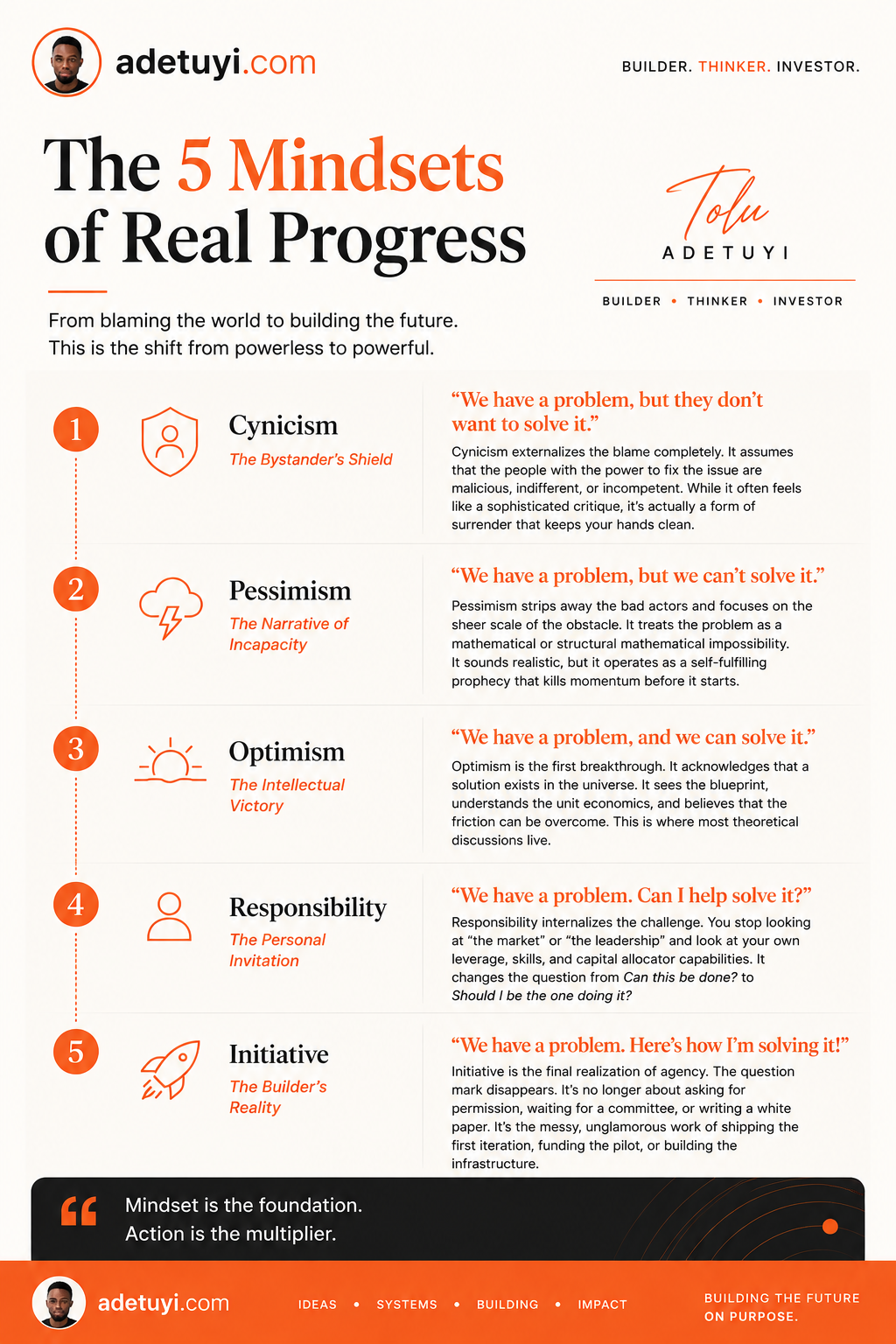
1. Cynicism: The Bystander's Shield
We have a problem, but they do not want to solve it.
Cynicism externalizes the blame completely. It assumes that the people with the power to fix the issue are malicious, indifferent, or incompetent. While it often feels like a sophisticated critique, it is actually a form of surrender that keeps your hands clean.
2. Pessimism: The Narrative of Incapacity
We have a problem, but we cannot solve it.
Pessimism strips away the bad actors and focuses on the sheer scale of the obstacle. It treats the problem as a mathematical or structural impossibility. It sounds realistic, but it operates as a self-fulfilling prophecy that kills momentum before it starts.
3. Optimism: The Intellectual Victory
We have a problem, and we can solve it.
Optimism is the first breakthrough. It acknowledges that a solution exists in the universe. It sees the blueprint, understands the unit economics, and believes that the friction can be overcome. This is where most theoretical discussions live.
4. Responsibility: The Personal Invitation
We have a problem. Can I help solve it?
Responsibility internalizes the challenge. You stop looking at the market or the leadership and look at your own leverage, skills, and capital allocator capabilities. It changes the question from "Can this be done?" to "Should I be the one doing it?"
5. Initiative: The Builder's Reality
We have a problem. Here is how I am solving it!
Initiative is the final realization of agency. The question mark disappears. It is no longer about asking for permission, waiting for a committee, or writing a white paper. It is the messy, unglamorous work of shipping the first iteration, funding the pilot, or building the infrastructure.
Why Smart People Get Stuck
You would think the hardest leap is moving away from the dark cloud of cynicism and pessimism. It isn't. For highly driven, analytical, and ambitious individuals, the heaviest lifting occurs in the gap between Optimism and Initiative.
Optimism is comfortable. For a smart person, proving that a problem can be solved is an intellectual victory. You can map out the architecture, design the workflows, or build the theoretical model in your head. Because the theory is flawless, it satisfies the brain's craving for achievement without demanding any actual skin in the game.
But moving from "This can be solved" to "Here is how I am actively solving it" is terrifying. Why? Because the moment you step into Initiative, you enter the arena of real-world friction. Theoretical models hit messy operational realities. The risk of failure becomes highly visible and deeply personal. You have to allocate actual capital, time, and reputation to a hypothesis.
Many high-performers disguise their fear of execution as perpetual optimization. They stay comfortably parked in the optimism stage, constantly tweaking the strategy, waiting for the perfect macroeconomic conditions, or looking for the flawless partner.
Moving the Needle
If you want to do exceptional work, you have to shorten the time it takes to get from the intellectual nod of optimism to the concrete action of initiative.
Stop waiting for them to want to solve it. Stop looking for absolute certainty that we can solve it perfectly. Instead, audit your current focus areas. Look at the biggest frustrations in your industry or project right now and ask yourself: Am I merely commentating on this, or am I building the architecture to fix it?
The world has an oversupply of brilliant commentators. What it lacks are the people willing to bridge the gap, absorb the execution risk, and say, "Here is what I am doing about it today."
This is just the first part. Now that we understand the psychological shifts required to reach Initiative, the next step is applying a structured process to make it happen reliably. You can read Part 2, The Framework of Agency, where I break down the operational framework I have adopted to bridge this gap, which continues to work incredibly well for me.
Written by
Tolu Adetuyi