The Paradox of a Father
I've been staring at some data the last few weeks. Not skimming it, actually sitting with it, trying to work out what kind of world we're building and, more to the point, who it's actually for.
I spend my days on the stuff people call building the future. Trust systems, capital, scale. Meanwhile another world has been quietly raising my daughter from the inside, and I only noticed recently. That's the paradox I can't shake: I build systems for a living, and a system I didn't build is already raising her.
I'm not writing this as someone who's figured it out. I'm a father of a three-year-old girl, and I build systems for a living, and I still don't know what to do about the one shift that actually keeps me up: what happens to her, to work, to parenting, once the ground under all three won't hold still.
Here's the data first. Then the part I can't answer.
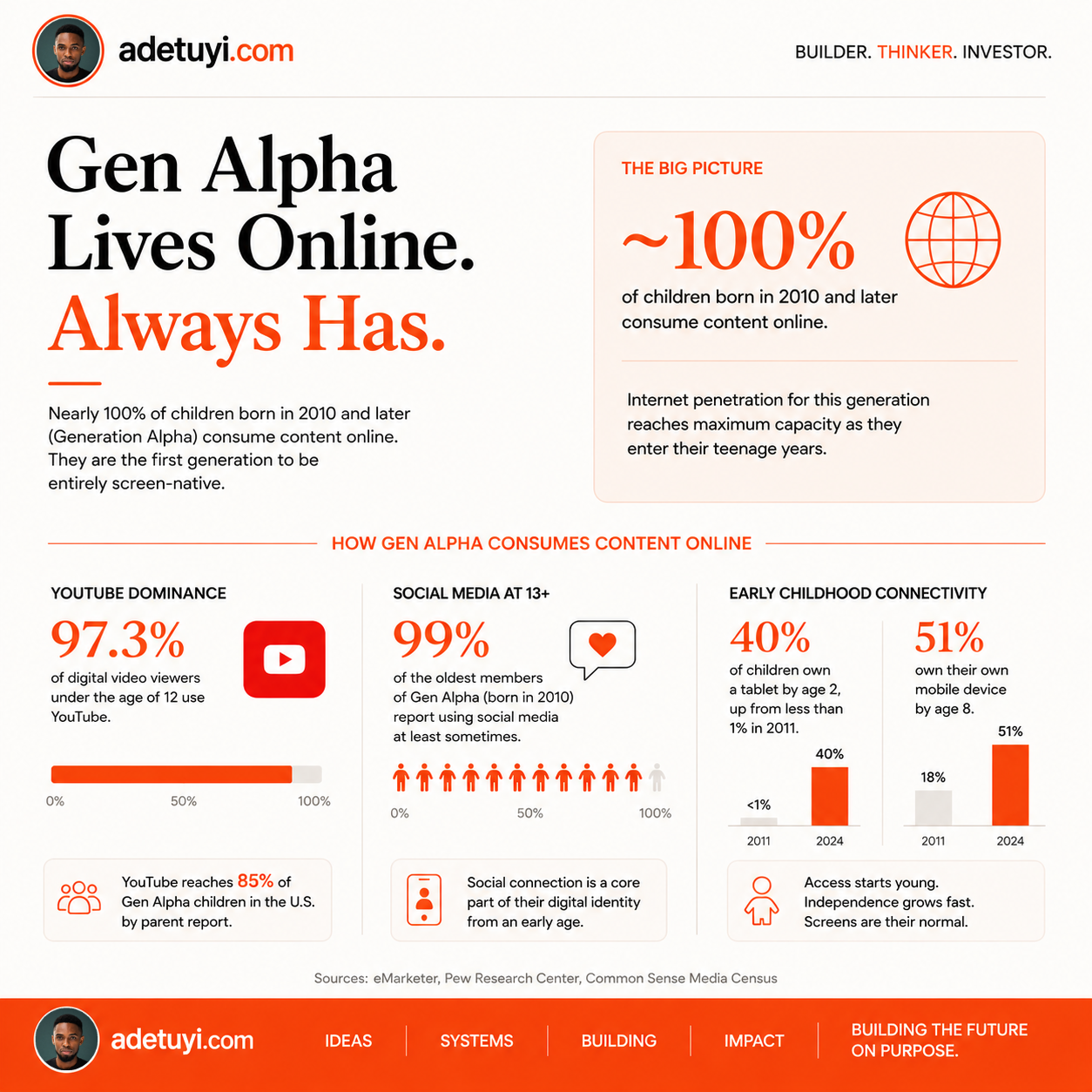
Screens got there before I did
I like to think I'm the main influence in my daughter's life. That what I model over dinner, what I correct on weekends, counts for more than anything else reaching her.
The numbers don't agree. Nearly every child born after 2010 is online before they're old enough to ask for a phone. Forty percent own a tablet by age two. Just over half have their own device by age eight. YouTube reaches something close to all of them.
Before she can find her own house on a map, she'll already belong to a digital world with no borders that doesn't slow down for anyone. She'll spend more of her waking hours in a YouTube recommendation loop or a game's reward system than in anything I actually built for her.
Now add AI on top of that. She's not just the first generation raised on streaming, she's the first raised alongside AI that talks back to her personally, in real time, the way I do.
Whatever she spends the most time inside will shape her more than whatever I say to her. Not because I don't matter, but because attention is the thing actually being fought over here, and right now I'm losing that fight by default.
What I don't have an answer to
This isn't a complaint about the people building these products. I'm one of them. It's not about stopping anything either. It's about whether we're choosing what gets built or just watching it happen to us.
I keep landing on the same fork and I don't know which side is right. Do we meet kids where their attention already lives and build something inside that same high-stimulation, competitive format, except aimed at actually giving them values instead of just holding their eyes? Or do we go the other way, build slow, physical, deliberately boring spaces that force presence and real contact, because the digital world will never give her that?
And even if we get that right, what do we teach her? Not what I was taught — that world is mostly gone. Character, judgment, clear thinking, those still hold. But linear execution, the kind of work that used to be an entire career, is something AI already does better than most adults. Teaching her for the world I grew up in is teaching her for a world that's already leaving.
Building on purpose
Insight sees the trend. Wisdom builds the system. That's the whole reason I'm doing any of this, and I don't think any of us get to sit this one out.
If you build things, fund things, or just have a kid, I think it falls on us to figure out how our children stop being raw material for someone else's product and start being the ones who decide what gets built next.
I don't have the balance worked out yet. What does a system look like that keeps her fully human and still ready for a world this digital? If you've got a better answer than mine, send me a note.
Work with me
If something in this piece resonated, that is usually where the conversation starts.
Written by
Tolu Adetuyi