The Architecture of Leverage
There is a precise moment in the trajectory of every serious builder where the exact thing that got you here becomes the thing that stops you from getting there.
In the early days, your superpower is direct execution. You survive on your ability to out-write, out-code, and out-hustle the ambiguity in front of you. The company is an extension of your hands, and that is exactly the right model for that stage. Speed comes from the founder being the engine.
But the moment the system grows from a localized project into something designed to outlast your personal energy, a brutal shift is required. If you stay the primary engine of execution, you become the primary bottleneck. It is that simple, and that uncomfortable. The transition is from solitary mechanic to ecosystem architect. You have to stop planting every seed and start designing the soil.
Designing the soil
When you hire brilliant people and then bottleneck them with your oversight, you pay a capital premium for talent while eliminating their actual execution capability. That is a waste of money and a waste of people.
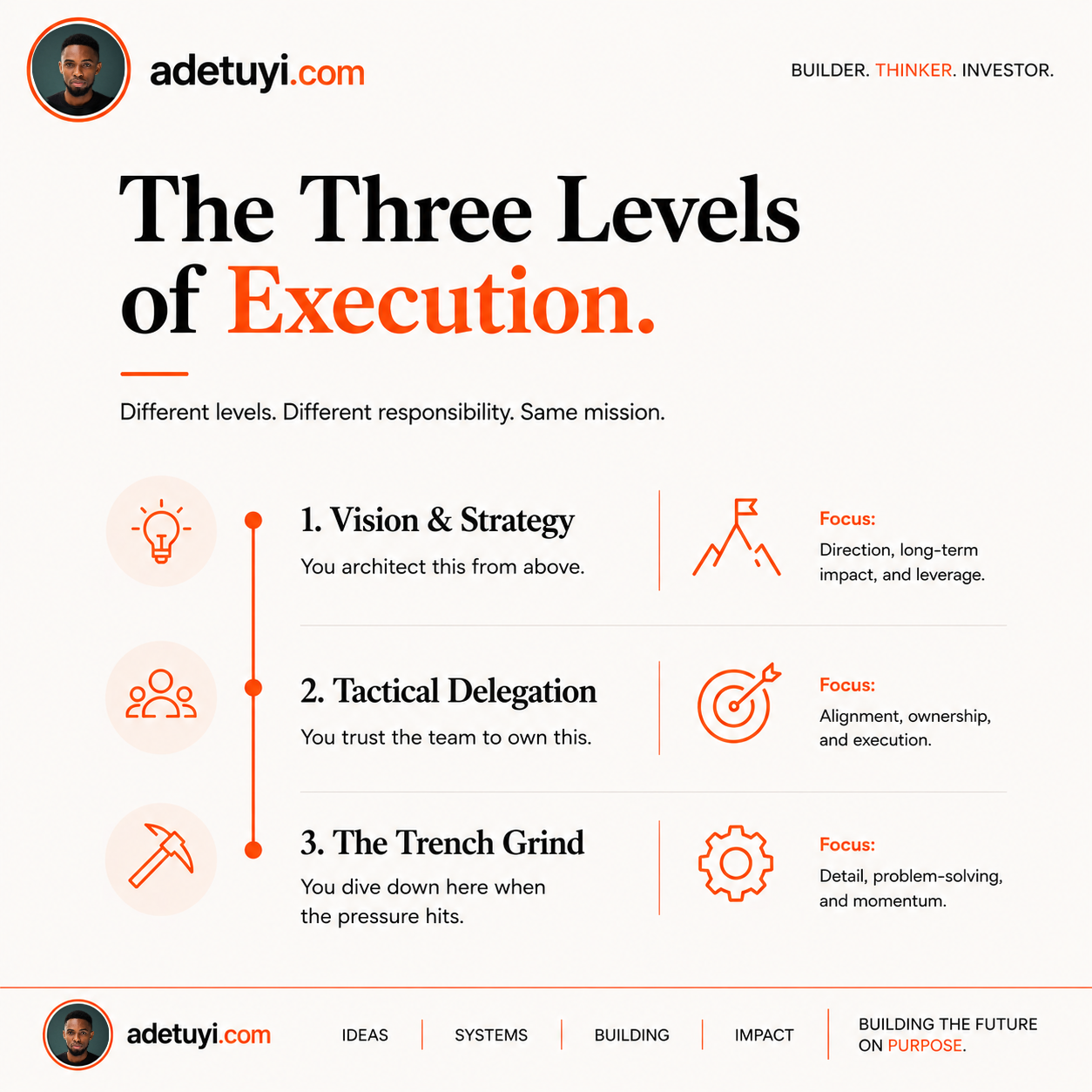
The job of a leader changes fundamentally as you scale. In the old model, the leader points at a task, the task gets done, value is created. Simple, direct, and completely unscalable. In the model that actually works at scale, the leader designs an environment. Autonomous talent operates inside that environment. Value flows from there.
The leader's cognitive load shifts away from individual tasks and toward the systemic problems that either threaten or accelerate the whole organization. You are no longer managing tasks. You are managing environment, alignment, and clarity. Get those three right, and value naturally moves in the direction you intend.
Vision as an operational tool
Vision gets cheapened by corporate habit. In most organizations, it lives on a wall or a slide deck and does nothing useful.
In high-stakes execution environments, vision is a practical operational tool. It is the relentless process of communicating the why so clearly that it eliminates friction in the how. When a team deeply understands where they are going and why it matters, they stop needing a checklist for every micro-decision. The vision becomes an internal compass. It gives them the context to make autonomous choices that align with the design, even when you are not in the room.
Vision without immediate context breeds cynicism. A leader must connect the ten-year horizon to this week's sprint.
If your team cannot see how their current task moves the long-term trajectory, the vision is just background noise. It has to land at the level of the work people are actually doing.
The resource mandate
This one gets ignored constantly, and it is a real failure of leadership when it does. You cannot demand institutional-grade output while providing subpar infrastructure. When you hand a complex problem to a team, your immediate obligation is to make sure they have the best tools, budgets, engineering frameworks, and data pipelines required to execute. Not adequate ones. The best.
Expecting a team to build resilient, high-velocity systems while structurally starved is a leadership failure, not an execution failure. True delegation means clearing the roadblocks before your team trips over them. You are their supply line, not just their commander. The distinction matters.
The paradox of the trench
This is where standard management theory breaks down. Delegation is not a shield from the dirt. It is not an administrative tool to insulate leadership from the realities of the grind.
Culture is not what you write on your Notion pages or your office walls. Culture is what your team observes and replicates.
When the pressure peaks, when a core system breaks at midnight, when an aggressive deployment timeline hangs in the balance, a true leader steps back into the trenches. Not to micromanage. Not to reclaim autonomy. To demonstrate shared conviction. When a team looks over and sees their leadership debugging a critical platform issue, reviewing a financial model line by line, or staying up to anchor a high-pressure launch, something shifts in them. They realize the mission is not a pitch deck. It is an unyielding commitment.
Your presence in the mud validates their sacrifice. That cannot be manufactured, and it cannot be delegated.
What flows downstream
Energy is contagious inside an organization. So is detachment. If a leader is aloof and purely transactional, middle management becomes political, protective, and risk-averse. That is what they observe. That is what gets replicated.
If a leader demonstrates deep curiosity, active involvement, and an uncompromising standard, that energy filters all the way down. It reaches the newest person on the team. When your people see that you are still a builder at your core, that you are willing to sweat over details when the stakes are high, they stop working for a paycheck. They start working to match your pace.
You do not build an organization of high-performing, autonomous owners by lecturing them on accountability. You build it by proving that no one at the top is ever above the work required to make the vision real.
That is the architecture of leverage. Design the soil. Cast the vision precisely enough that it becomes a compass. Resource your people properly. Get into the trenches when it counts. Then watch what they build.
Written by
Tolu Adetuyi